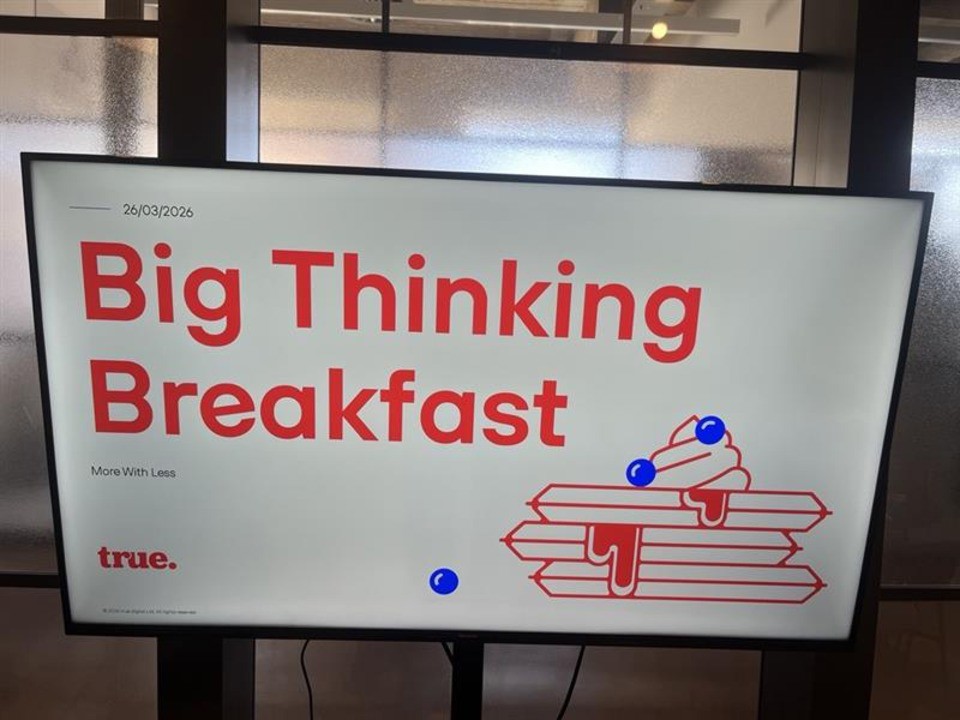
Big Thinking Breakfast - “More With Less”
Synopsis of discussion and takeaways.

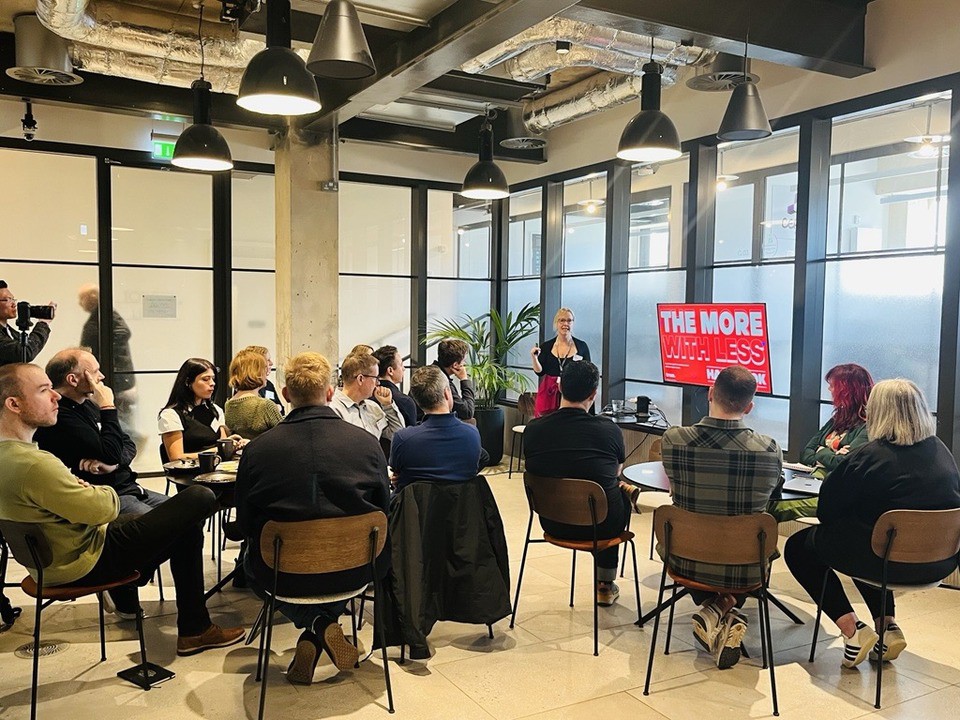
What does More with Less means for our clients - Mette Davis
Mette opened the breakfast session discussing today’s operating reality - most businesses are facing the same pressure: flat budgets, rising expectations, and a constant demand to deliver more impact with fewer resources. The session reinforced that while teams are feeling stretched, the biggest gap isn’t effort but the time to focus on the things that actually move the needle.
What teams wish they had more time for:
More face‑time with customers to deeply understand their needs.
Reflective, strategic thinking to craft stronger, more effective solutions.
Improving tools, workflows, and briefs rather than working around sub‑optimal inputs.
Refining craft and execution, not just shipping outputs.
Growth starts with what you already have
The discussion made clear that meaningful growth rarely comes from adding more activity. Instead, it comes from maximising the value of existing assets, channels, and capabilities.
Differentiation doesn’t require “More”
Mette set up the discussion by talking about the implications of doing “more” on businesses, and that true differentiation is driven by:
Clarity - a sharp understanding of what you stand for.
Consistency - showing up reliably across every touchpoint.
Emotional impact - making people feel something memorable.
Intentional foundations - decisions guided by strategy, not speed or volume.
Key takeaway: Avoid the temptation to do more. Focus on making better decisions about where the effort goes.
AI‑powered discovery: Why the new world of brand discovery is good news for good marketers - Dave Jones
Dave introduced the idea that the way people discover brands is changing fast and that’s great news for marketers who are clear on what they stand for.
Google’s recent work on The Four S’s— streaming, scrolling, searching and shopping, shows how the consumer journey has shifted. Traditional channels have flat‑lined, while native AI search platforms are growing year on year.
People aren’t just using new discovery tools, they’re using them differently. Searches now come with richer context, personal specifics and clear buying intent.
As Rand Fishkin put it:
“AI prompting is nothing like searching Google. People don’t reduce their search intent to a tidy set of 2–5 keywords. They get creative, weird, and highly specific.” SparkToro, Jan ’26
For brands, this flips the challenge: it’s no longer enough to be discoverable. You need to be recommendable.
That means consistently signalling the context in which your product solves a problem and why you do it better than your competitors.
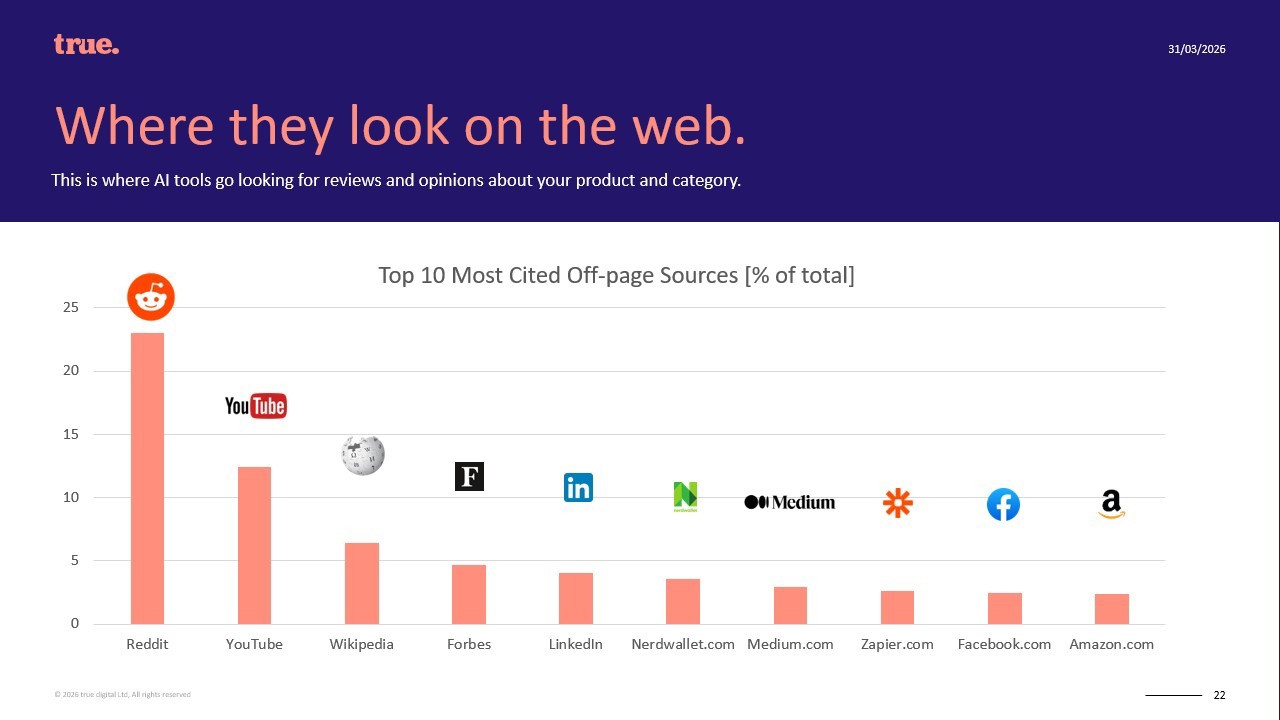
Where AI models look for information
The most common site areas AI tools crawl for brand and product signals are shown below so getting the basics right of your website is more important than ever.
Blog: 44%
Homepage: 18%
Product pages: 14%
Other: 24%
Three actions from true:
Decide what you want to be known for. Get a clear strategy and optimise around it.
Use your website to signal your strengths. Blogs, buyer guides and evergreen content help you show up in contextual, GEO‑specific searches.
Show up where your customers already are. Be active in the places and conversations that shape your category.
The value of brand consistency in a time of flux - Nick Horne
Change is the only constant and in new spaces that change is accelerating.
Meta’s new algorithm, Andromeda, has shifted how brands publish, optimise and even speak on social. The result? Less control for brands, more dependency on platform logic.
At the same time, the centre of gravity has moved from paid media at scale to paid influencers at scale with brands borrowing interest by appearing in someone else’s world. Increasingly, AI tools are selecting influencers automatically, which means brands have even less control over how they’re represented.
Recent YouGov’s research across 17 markets shows the tension clearly:
Half of consumers feel uncomfortable with brands using AI to create ambassadors or generate/edit advertising imagery. (YouGov, early 2024)
Brands are now managing a difficult balance: content quantity vs flat budgets. AI helps scale creation, but when every tool is trained on similar datasets, outputs start to converge. Feeds start to blur into a sea of sameness meaning brands get washed away in a tide of identical influencers and interchangeable visuals.
Nick made the point that five years ago, most brands would have rejected stock imagery for their ads. Today, AI-generated content is fast becoming the new stock - easy, efficient, and dangerously generic.
But it’s not just consumer facing brands that are impacted. We’re seeing this erosion of distinctiveness across ecommerce and B2B, where generic creative means no emotional connection with the customer.
And we know that emotion is the leverage point:
Up to 95% of purchase decisions are driven by emotion.
39% uplift in memorability when emotional design techniques are used.
So, we reiterate again, now is the time to really fix and double down on the foundations.
“In a world where people shift instantly between feeds, apps, and devices, fragmented creative burns brand equity. Distinctive assets, narrative clarity and strong linkage matter more than ever- because algorithms depend on those signals to judge relevance and amplify content across platforms.” (SVP, Media Solutions Lead, Kantar)
Three actions from true:
Customer Experience: Make your end‑to‑end experience seamless, online and offline. Load it with emotion, distinctiveness, and memorability - the things algorithms can’t manufacture.
Platform: Get your tech architecture in order. You need the right foundations to deliver consistent, joined‑up experiences wherever your audience shows up.
Revisit brand guidelines: Set a clear tone, behaviour and visual identity. Strong guardrails prevent confusion and prevent AI drifting you off-brand.
Busting myths on Tech - Matt Sutherland
Matt started his session reiterating the pressure our teams are under with 75% of marketers are under pressure to cut martech spend in 2026.
We know that tech is evolving fast, and it should be an enabler but often it brings complexity, cost concerns, and tension between marketing and IT.
A lot of this comes down to myths - assumptions that stop teams having productive conversations about progress. The good news: there are solid principles and tools that solve these problems.
Myth buster 1: “We want a rebrand, but it’ll be expensive and complicated - especially with multiple brands and sites.”
A headless architecture tackles this directly.
With a headless setup, all content sits in one central CMS. From there, you can update themes, branding, and content across multiple sites without rebuilds, duplication, or technical headaches.
A headless CMS gives you:
One place to manage multiple brands
Easy updates and fast changes
Flexibility to adapt to new requirements
Control over when and how sites launch
In short: flexible, efficient, cost‑effective.
Myth buster 2: “Changing one of our third‑party tools will break everything. IT will say no or demand a full rebuild.”
This is where composable architecture comes in.
Composable means building your platform so tools are modular and not locked together. In simple terms: the front end and back end are separated, making it easy to test tools, swap out providers, or add new functionality without disruption.
With a composable setup, you can:
Replace old tools or add new ones without drama
Test solutions quickly
Build a CMS that fits your business (not the other way around)
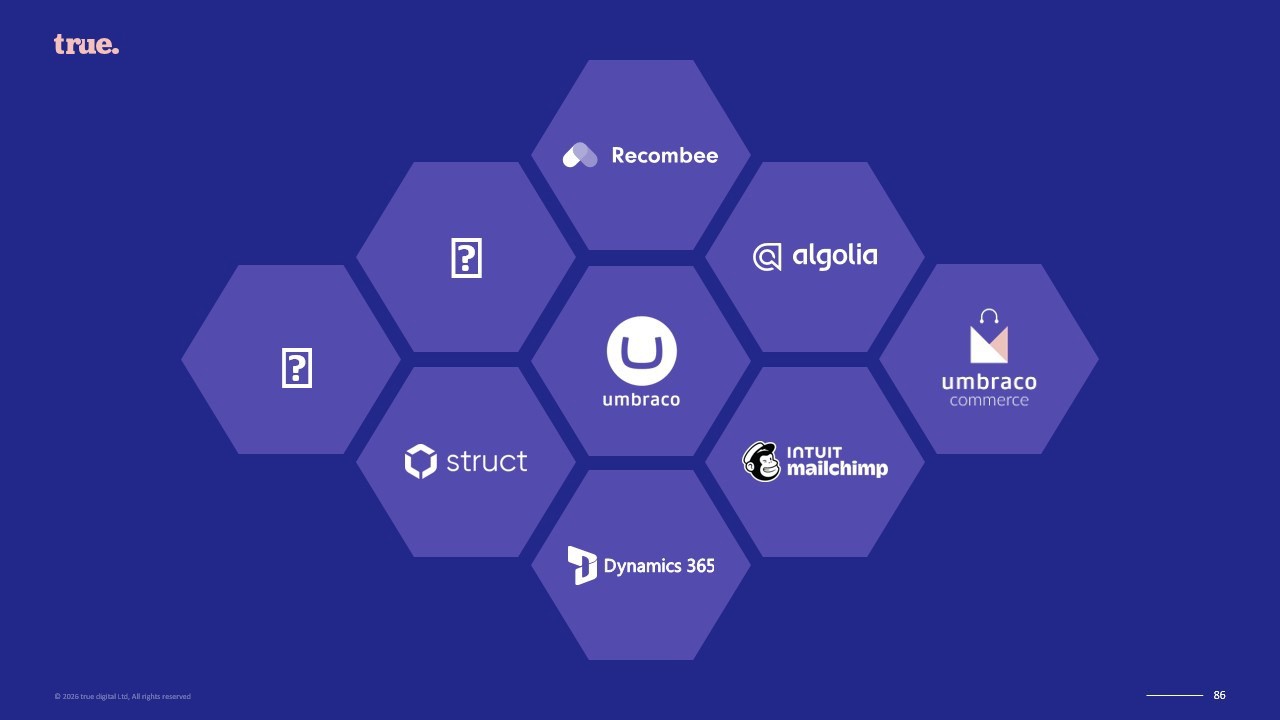
The magic happens when you combine both
Headless + composable = a platform that is:
Scalable
Flexible
Fast to launch
Built for long‑term value
Ready to support growth
It’s the difference between wrestling with legacy tech and building a system that actually works for your business.
Three actions from true:
Run a combined discovery workshop: Align IT and marketing on shared goals. Create one view of what matters and prioritise from there.
Review your existing tech ecosystem: Assess what you have today, objectively. Identify what supports your goals and what’s holding you back.
Build a clear roadmap: Define the steps, deliverables and dependencies needed to reach your shared strategic vision.
Wrapping up:
The breakfast closed with a moment of reflection, giving attendees the opportunity to consider where they’re seeing the greatest momentum and which conversations they need to start back in the office.
We encouraged everyone to commit to taking at least one key insight forward and invited each person to share the action or idea they plan to implement next.
If you’d like to explore any of the themes from the session in more detail, our experts would be happy to continue the conversation. Book a meeting here: